Can You Still Walk Up Coba Ruins?
Yes, Nohoch Mul pyramid at Coba is open again. Here are the new climbing rules, ticket info, the best tours from Tulum, and how it compares to Chichen Itza and other sites.
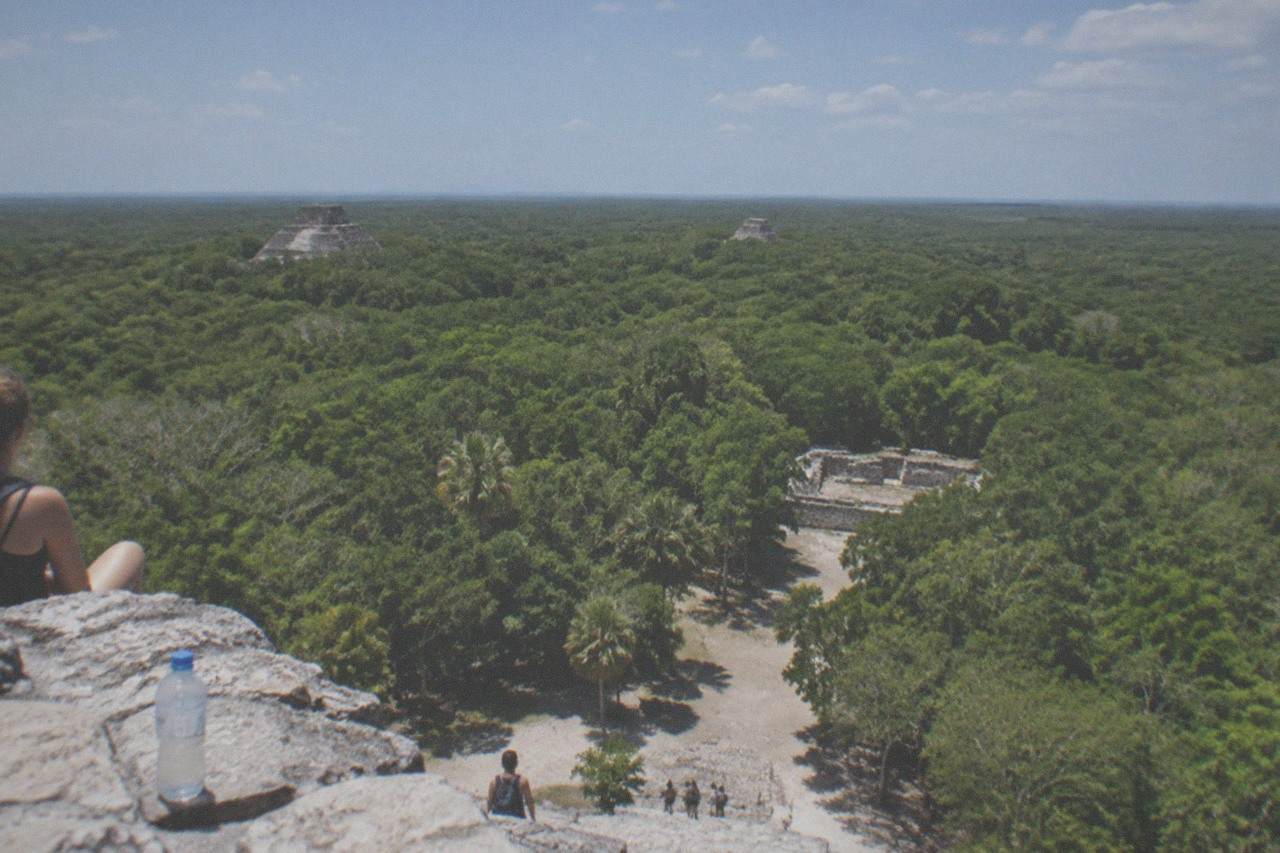
For nearly six years the answer was no. Coba's towering Nohoch Mul pyramid, the tallest Maya structure on the Yucatán Peninsula at 42 meters, sat off-limits to climbers while other pyramids stayed closed too. That changed on December 8, 2025, when the site reopened the climb with a brand-new wooden staircase and a fresh set of rules designed to protect the centuries-old monument and its visitors. Today, Coba and Ek Balam are the two major ruins near the Riviera Maya where you can still haul yourself up a genuine ancient pyramid, and at Coba the view runs out over an endless jungle canopy. As Tulum Ruins Tours sees it, that climb is what now pulls many travelers the 45-minute drive from the coast.
Can You Still Walk Up Coba Ruins?
Yes, Nohoch Mul at Coba is open to climb. The 42-meter pyramid reopened around December 8, 2025, after a roughly six-year closure. A new wooden staircase covers the original 120 stone steps. Small groups of 14 to 15 people ascend at a time, the climbing window runs 8:00 AM to 3:30 PM, summits are capped at 15 minutes, and closed-toe shoes with grip are mandatory. No comparable pyramid nearby allows a summit climb.
The reopening is a genuine shift for any Maya ruin day trip. Where Chichen Itza's El Castillo has been off-limits to climbing since 2006, and the Tulum ruins never permitted it at all, Coba is once again the place for a literal hands-on experience. The new wooden staircase follows the original stair's path, so you still get the same dizzying angle and the same final reward: an uninterrupted view across the Quintana Roo jungle that stretches to the horizon in every direction. A full guide to the site is worth reading before you go, because Coba's sprawling 70-square-kilometer layout demands a plan, and the climb line is only one piece of a much larger archaeological zone.
Because the climb window closes at 3:30 PM, a morning arrival makes the most sense. The site opens at 8:00 AM, and the first hour is often the quietest. By late morning the pyramid line can stretch, and it only gets hotter as the day goes on. Most guided tours from Tulum schedule their visits in the morning for exactly that reason. If you want to stand on top of Nohoch Mul, plan to be at the ruins early and check the climb queue as soon as you arrive. The pyramid sits deep inside the site, roughly a two-kilometer walk or a quick bike ride from the entrance along the ancient sacbeob, those raised limestone causeways that once connected Coba to its satellite settlements.
What Are The New Climbing Rules At Nohoch Mul?
Nohoch Mul's climb operates under a strict daily regimen. Small groups of 14 to 15 people ascend at a time, with a summit stay capped at roughly 15 minutes. The new wooden staircase is mandatory, closed-toe grip shoes are compulsory, and the climbing window runs 8:00 AM to 3:30 PM. These rules balance conservation with the demand for access, and site staff enforce them consistently throughout the day.
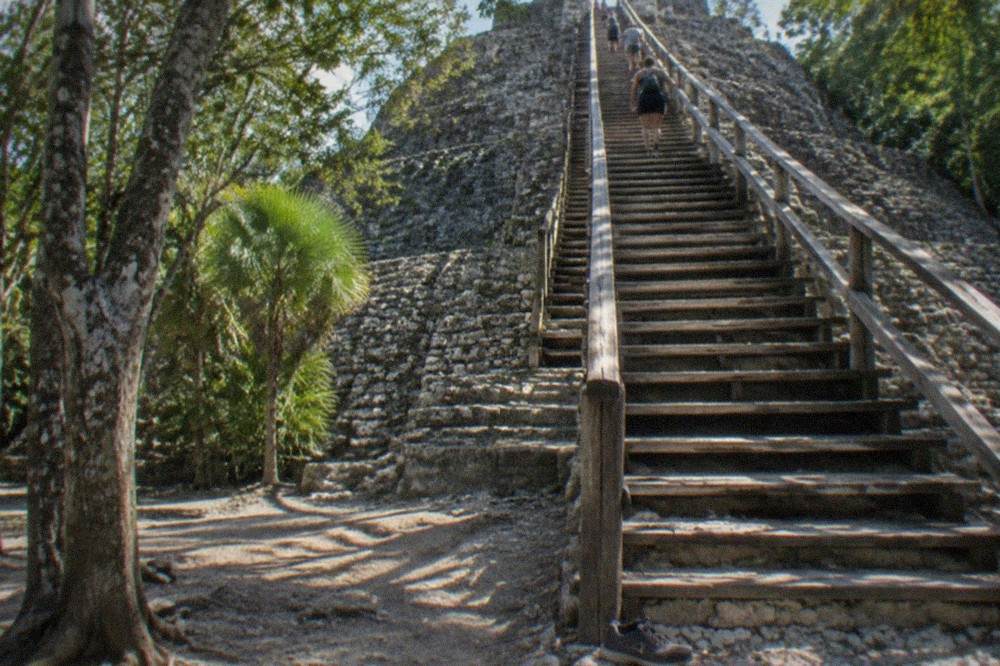
The INAH and local community developed the system together after the site's reopening became official. The 15-minute summit limit is enforced by staff who manage the line, but in practice it is enough time to catch your breath, snap photos, and feel the breeze before descending. The staircase itself is a smart piece of engineering: a narrow wooden structure that hugs the pyramid's profile without altering it, letting you ascend and descend without touching the original stone. The climb is steep, rising the full 42 meters of the pyramid's flank, and the wood can be damp from morning dew or rain, which is why the shoe rule is taken seriously.
Flip-flops, sandals, any heel, or barefoot access will not fly. Light hiking shoes, trail runners, or sturdy sneakers work best. Bring water, but be ready to carry it in a daypack because there is no reliable drink stand near the pyramid base. The line moves steadily most days, though weekends and holidays bring heavier traffic, and on those mornings the wait can stretch past 20 minutes before you set foot on the first step. A quiet Tuesday in the low season might see no line at all by late afternoon, though you will still need to be on the staircase before the 3:30 PM cutoff.
Compared to the years before the closure, when climbers scrambled up bare stone without time limits, the new setup feels more like a managed heritage experience, but it is still very much a climb. The view from the summit and the sense of scale are unchanged, and the feeling of standing on a platform that once served as a ceremonial lookout over a city of 50,000 people is exactly what makes the trip worthwhile.
How Does Climbing At Coba Compare To Chichen Itza And Tulum?
Coba and Ek Balam are the two major Riviera Maya pyramid sites that still allow a summit climb. Chichen Itza's El Castillo has been fully closed to climbers since a fatal fall in 2006; even interior access to the Red Jaguar Throne is shut. Tulum's ruins never permitted climbing on any structure due to coastal erosion and fragile stonework. Ek Balam's Acropolis offers a rope-assisted stone staircase, but the site sits much farther from the coast and draws far fewer visitors than Coba.
The climbing rules across these sites tell a consistent story: ancient Maya pyramids were not designed to handle mass tourism. At Chichen Itza, the blanket climbing ban has been in place for two decades and is not expected to change. Barriers keep visitors several meters back, and the pyramid is observed rather than touched. The federal INAH fee and the Yucatán state CULTUR fee together bring a foreign adult entrance to roughly 697 MXN, and the roughly two-hour drive from Tulum via the 180D toll road means a full day commitment, yet no one gets to set foot on a single step of El Castillo.
At Tulum, even standing on the Castillo's lower terrace is off-limits. The unified entrance fee, set at 265 MXN for foreign visitors after the July 2026 decree, covers INAH and CONANP access to the archaeological zone and Parque del Jaguar, but the structures themselves are for viewing only. The Temple of the Descending God, the Temple of the Frescoes, and El Castillo all sit behind ropes. The experience is spectacular because of the Caribbean backdrop, but it is a walking tour, not a climbing experience. Why the region's biggest pyramids banned climbing explains the conservation pressures in more detail, but the contrast with Coba is what drives the decision for many travelers.
Coba's reopening is the notable exception. The new wooden staircase and the time limits are the compromise that made it possible, and it is a genuine contrast: you can walk the steps, stand on the summit platform, and see the same perspective the Postclassic Maya saw. That lived-in feeling does not exist at any other major site a day trip from Tulum.
| Site | Pyramid | Climbing Status | Height | Key Rules |
|---|---|---|---|---|
| Coba | Nohoch Mul | Open (Dec 2025) | 42 m | Wooden staircase, 14-15 per group, 15-min summit limit, closed-toe shoes, 8 AM-3:30 PM window |
| Chichen Itza | El Castillo | Closed since 2006 | ~30 m | Banned permanently, barriers and distance enforced, interior shut |
| Tulum | El Castillo | Never permitted | ~7.5 m | Viewing only, fragile coastal setting, all structures roped off |
| Ek Balam | Acropolis (El Trono) | Open | ~43 m | Steep stone steps with rope assist, new western section opened 2026, small-group access |
So the current landscape is clear. If you want to climb a major Maya pyramid on a day trip from Tulum, Coba is the answer, and booking a well-organized tour is the simplest way to make it happen. The two-ticket cash system, the bike or pedicab rental inside the site, and the early start needed to beat the climb queue all become straightforward when an operator handles the logistics. The tour that pairs Coba with Punta Laguna Nature Reserve and a cenote swim is the strongest single-day package on this list, wrapping every fee and meal into one price.
Ek Balam, at roughly 1.5 to 2 hours from Tulum, is the only other climbable pyramid on the radar, and its Acropolis offers a rope-assisted stone ascent up a 43-meter facade with far smaller crowds. A new section of the Grand Acropolis opened to visitors in 2026. But it sits on the far side of Valladolid, making it a longer haul than Coba and less commonly paired with a cenote in a single half-day format.
What Is The Best Way To Visit Coba From Tulum?
The best way to visit Coba from Tulum is by joining a guided day tour that bundles transport, entrance, the climb, and usually a cenote swim, handling the two-ticket cash payment and bike or pedicab rental required to cross the 70-square-kilometer site. Arrive by 8:00 AM to beat the climb queue, whether you book a tour or drive the straightforward 45-minute route yourself.
Several combos tie the climb to a larger experience. One of the strongest full-day options is a tour that pairs Coba with Punta Laguna Nature Reserve, a nearby cenote, and a visit with a Maya family. The tour includes all entrance fees, lunch, and round-trip transport from Tulum-area hotels, so the only cash you need is for a cold drink or a tip. The post-reopening reports from early 2026 consistently mention the Punta Laguna add-on as a highlight because you get the pyramid, then the jungle and a cenote, without rushing. If your priority is climbing Nohoch Mul and you want a single booking that handles every detail, this is the one to look at first.
A smaller-group alternative is a 10-hour minivan tour that adds the Multun Ha cenote and the Maya Museum after Coba itself. Transport, Coba entry, and the cenote entrance are included, while the Tulum ruin fee on that specific itinerary is an extra cost payable on the day. The minivan format keeps the group intimate, and the guided commentary inside Coba's site helps you spot details like the ball court and the sacbeob that are easy to miss on your own. The pace is steadier than the larger bus tours, and the cenote stop at Multun Ha is a quiet contrast to the climb.
A third option worth knowing about is a Riviera Maya departure that combines Coba with the Tulum ruins and a swim at Cenote Mariposa, all with a Mayan traditions demonstration and lunch included. It is the most affordable way to hit two major archaeological zones in one day, and it covers the climb at Coba alongside the coastal ruins at Tulum. You will not get the intimate group size of the private or small-group tours, but for travelers who want to see both sites without renting a car and managing two separate entries, it is a practical choice. Combining Tulum and Coba in one day takes some planning, and a tour that handles the two-ticket system at Coba plus the unified entrance at Tulum saves real time and stress.
If you drive yourself, the route is Highway 307 north from Tulum toward Cancun, then inland on well-signed roads toward the town of Coba. Parking at the site costs around 60 to 80 MXN, and from the lot it is a short walk to the entrance gates. Both the INAH and ejido ticket windows take cash only, and small bills help because change can be scarce. Having roughly 400 MXN per person in mixed denominations covers the entrance fees, parking, and a bike rental comfortably.
What Should You Bring For The Climb?
Closed-toe shoes with good grip are non-negotiable for the steep wooden stairs. Carry at least one liter of water per person, a small daypack, and sun protection: hat, lightweight long sleeves, and sunglasses. Mosquito repellent helps on the jungle paths. Cash in Mexican pesos is essential because the two entrance tickets and bike or pedicab rentals are cash-only. A towel and a change of clothes make sense if your tour includes a cenote swim.
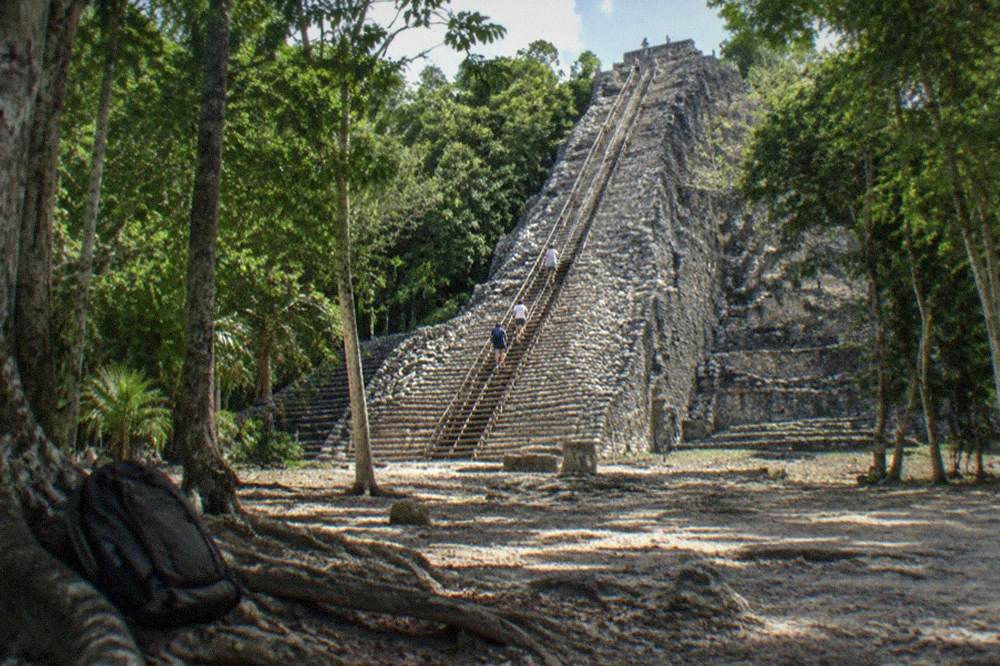
During the dry season, roughly November through April, the jungle trail to the pyramid is less muddy but still humid. In the wetter months an early start helps you avoid afternoon downpours. There is no café inside the archaeological zone itself, only drink vendors near the parking lot, so all snacks and water must be carried in. A lightweight rain shell stuffed into your pack weighs almost nothing and is better than getting soaked on the descent, especially because wet wood on the staircase can make the climb slower for everyone behind you.
Cash planning deserves a specific mention. The current entrance system at Coba requires two separate payments: one federal INAH ticket and one local ejido ticket, totaling around 310 to 330 MXN for foreign adults. Parking, if you drive yourself, adds another 60 to 80 MXN. A bike rental inside the site is roughly 60 to 100 MXN, or a pedicab for two costs around 140 to 200 MXN. Drivers often provide informal commentary along the way, pointing out ceiba trees, unexcavated mounds, and the occasional spider monkey. Having a few hundred pesos in small denominations avoids delays at the ticket windows. Mexican nationals and residents pay a reduced rate, and Sundays are free for nationals with valid ID, though that day draws heavier crowds and a longer climb queue.
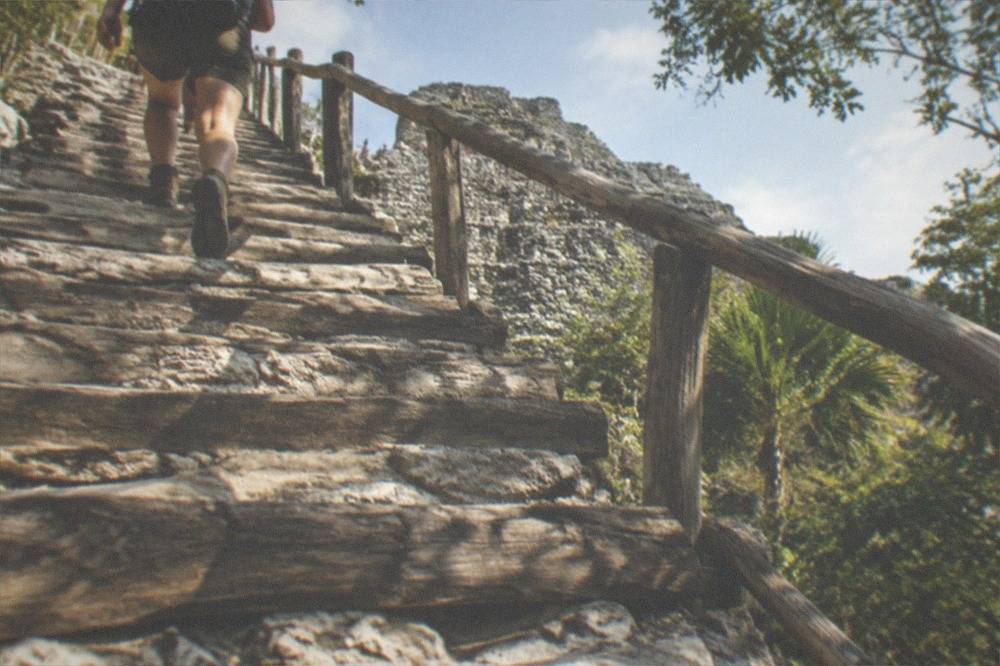
A guided tour that includes Coba and a cenote often comes with the same cash rules but hands the fee handling to the operator. You will still want pesos for any extras like souvenirs or a post-climb coconut water at the parking lot stands. The climb itself is a direct, steep ascent with alternating one-way traffic on the staircase to let descending groups pass. The summit platform is open to the sky, with views that sweep across thick, green jungle canopy in every direction. After a couple of minutes the absence of noise registers: bird calls, the breeze, and the sheer scale of a site that once held 50,000 people spread across dozens of square kilometers of connected settlements. The descent is faster but demands the same care on the wooden steps, especially if your legs are tired from the climb up.
Common Questions About Climbing Coba's Pyramid
can you still walk up coba ruins?
Yes. The climb reopened on December 8, 2025. Visitors now use a new wooden staircase over the original stone steps, with small groups, a daily climbing window of 8:00 AM to 3:30 PM, and a 15-minute summit limit. It is one of two major pyramid climbs currently available near the Riviera Maya, the other being Ek Balam's Acropolis.
Is Nohoch Mul Open To Climbers Every Day?
The pyramid is open daily during regular site hours, 8:00 AM to 5:00 PM, but the climb window closes earlier at 3:30 PM. There is no weekday or weekend shutdown, though holiday periods and free-admission Sundays for Mexican nationals can bring especially heavy crowds and longer queues for the staircase.
What Shoes Are Required For The Coba Climb?
Closed-toe shoes with good grip are obligatory. Flip-flops, sandals, heels, and bare feet are not permitted. Hiking shoes, trail runners, or sturdy sneakers work best on the steep wooden staircase. The rule is enforced by site staff at the base of the pyramid.
How Much Does It Cost To Climb Coba's Pyramid?
There is no separate climbing ticket. The standard entrance fee includes access to Nohoch Mul. Foreign adult visitors pay around 310 to 330 MXN across two cash-only ticket windows, covering the federal INAH fee and the local ejido fee. The fee also covers the rest of the extensive archaeological site.
Can You Climb Chichen Itza Or Tulum Instead?
No. Chichen Itza's El Castillo has been closed to climbers since 2006, and the Tulum ruins never allowed climbing on any structure. Coba and Ek Balam are currently the only two major pyramid sites near the Riviera Maya where you can legally climb.